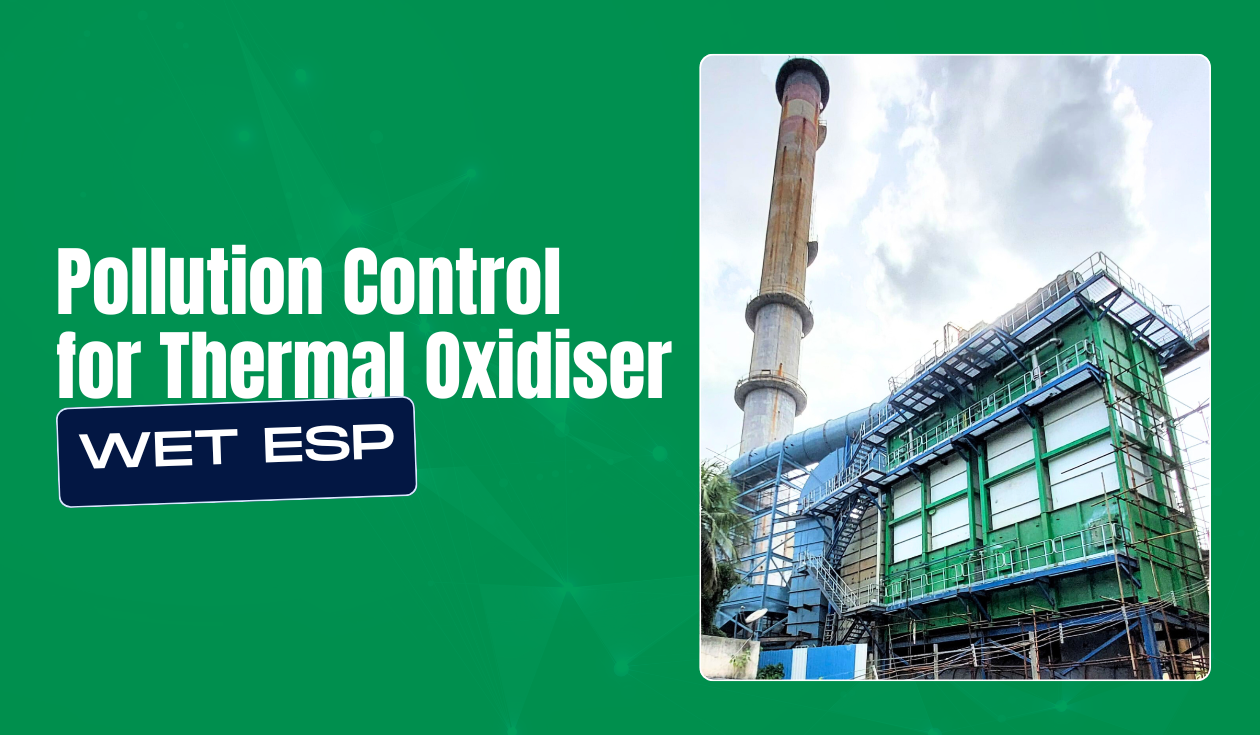
Pollution Control for Thermal Oxidiser – Wet ESP
High-temperature industrial operations inevitably generate gaseous emissions and fine particulates that must be treated before release into the atmosphere. In sectors such as chemicals, petrochemicals, pharmaceuticals, and specialty manufacturing, thermal oxidisers are widely installed to destroy volatile organic compounds (VOCs) and hazardous air pollutants (HAPs). While thermal oxidation is highly effective in breaking down organic contaminants through controlled combustion, it can also create secondary by-products in the form of acid mists, condensable vapours, and submicron particulate matter.
To ensure complete environmental compliance, these residual pollutants require an additional polishing step. This is where the Wet Electrostatic Precipitator (Wet ESP) becomes essential. By integrating a Wet ESP downstream of a thermal oxidiser, industries can significantly enhance particulate removal efficiency and meet increasingly stringent emission standards.
Learning to Run Thermal Oxidisers
Thermal oxidisers function by exposing contaminated exhaust gases to high temperatures, typically ranging between 760°C and 1,100°C, depending on the design and application. At these elevated temperatures, VOCs oxidise into carbon dioxide (CO₂) and water vapour (H₂O). Regenerative Thermal Oxidisers (RTOs) and Recuperative Thermal Oxidisers are commonly used configurations that improve fuel efficiency while ensuring high destruction removal efficiency (DRE), often exceeding 99%.
Despite their effectiveness in decomposing organic gases, thermal oxidisers do not always eliminate ultra-fine particulate matter or acid aerosols formed during the cooling stage of exhaust gases. When hot flue gases exit the oxidiser and begin to cool, condensable vapours can nucleate into fine droplets. These particles are frequently less than one micron in diameter, making them difficult to capture using conventional dry filtration systems such as bag filters or cyclones.
If left untreated, these emissions may contribute to visible plumes, opacity issues, acid deposition, and respiratory health concerns. Therefore, a downstream air pollution control device becomes critical to address these fine contaminants.
Use of Wet Electrostatic Precipitator
A Wet Electrostatic Precipitator (Wet ESP) is specifically engineered to remove submicron particulates, liquid droplets, acid mists, and metal fumes from industrial exhaust streams. Unlike dry electrostatic precipitators, which rely on mechanical rapping to dislodge collected particles, a Wet ESP continuously washes its collection surfaces with water.
The working principle is straightforward yet highly effective. As exhaust gases pass through the unit, a high-voltage electrical field ionises the particles suspended in the gas stream. These charged particles migrate toward grounded collection electrodes. Instead of accumulating as dry dust, they are flushed away by a continuous water film.
This wet operation prevents re-entrainment of particles and eliminates the risk of dust buildup. It also makes the system particularly suitable for handling sticky, hygroscopic, or corrosive materials—conditions commonly encountered downstream of thermal oxidisers.
Because of its ability to remove extremely fine particles and mist, the Wet ESP acts as a polishing stage, ensuring cleaner stack emissions.
The Wet ESP Enhancement of Pollution Control
When installed downstream of a thermal oxidiser, a Wet ESP significantly enhances overall pollution control performance. Studies and operational data show that Wet ESP systems can achieve particulate removal efficiencies exceeding 99% for submicron particles.
This level of performance is critical for industries operating under strict emission norms for particulate matter (PM), sulfuric acid mist, and visible plume limitations. By removing fine aerosols and acid droplets, the Wet ESP prevents the formation of white plumes often visible at stack outlets.
Another operational advantage lies in the continuous washing mechanism. Since collection surfaces are constantly rinsed, there is minimal risk of performance degradation due to fouling. This ensures consistent operation over extended periods, reducing downtime and maintenance interruptions.
Additionally, the pressure drop across a Wet ESP is typically lower than that of fabric filters, which can translate into reduced energy consumption and lower operating costs over time.
Environmental and Operating Advantages
From an environmental standpoint, integrating a Wet Electrostatic Precipitator improves air quality by reducing fine particulate emissions that pose serious respiratory risks. Fine particulate matter (PM2.5 and smaller) can penetrate deep into the lungs and bloodstream, contributing to cardiovascular and pulmonary diseases. By capturing these ultra-fine particles, industries contribute to safer working environments and healthier surrounding communities.
Wet ESP systems also reduce odor issues associated with certain industrial processes. Acid mists and residual aerosols often carry odorous compounds; their removal results in improved environmental acceptance and reduced community complaints.
Operationally, the system’s ability to handle variable gas conditions makes it versatile. It performs effectively even when dealing with saturated or high-humidity gas streams. Furthermore, the wet design minimizes fire hazards that may arise in dry dust-collection systems when handling combustible materials.
Maintenance requirements are generally predictable and manageable, primarily involving inspection of electrodes and water circulation systems. The absence of mechanical rapping systems simplifies design and reduces mechanical wear.
Combination in Industrial Pollution Control Systems
Wet ESP technology has found widespread application in industries such as chemical manufacturing, petrochemicals, fertilizer production, pharmaceuticals, steel pickling lines, and waste treatment facilities. In these sectors, thermal oxidisers are often used to control VOC emissions, while Wet ESPs serve as the final stage to remove particulate matter and acid aerosols.
This integrated approach creates a comprehensive air pollution control system capable of addressing both gaseous and particulate pollutants. Thermal oxidation handles organic contaminants, while the Wet ESP ensures removal of residual mist and ultra-fine particles.
Such combined systems are particularly valuable in processes generating sulfuric acid mist, phosphoric acid aerosols, or metal fumes. By adopting this layered control strategy, industries not only achieve regulatory compliance but also improve operational reliability and corporate environmental responsibility.
Conclusion
Effective pollution control in thermal oxidiser systems extends beyond VOC destruction. While thermal oxidisers play a crucial role in reducing harmful organic emissions, they must be complemented by advanced particulate removal technologies to ensure comprehensive emission control.
The Wet Electrostatic Precipitator stands out as a highly efficient solution for capturing submicron particles, acid mists, and condensable aerosols generated during and after thermal oxidation. Its ability to maintain high efficiency, low pressure drop, and stable long-term operation makes it a preferred choice in demanding industrial environments.
Engineering companies such as Enviropol continue to design and implement integrated air pollution control solutions that help industries operate responsibly while meeting evolving environmental regulations. By combining thermal oxidisers with Wet ESP systems, industries can achieve cleaner emissions, improved compliance, and a measurable reduction in environmental impact.