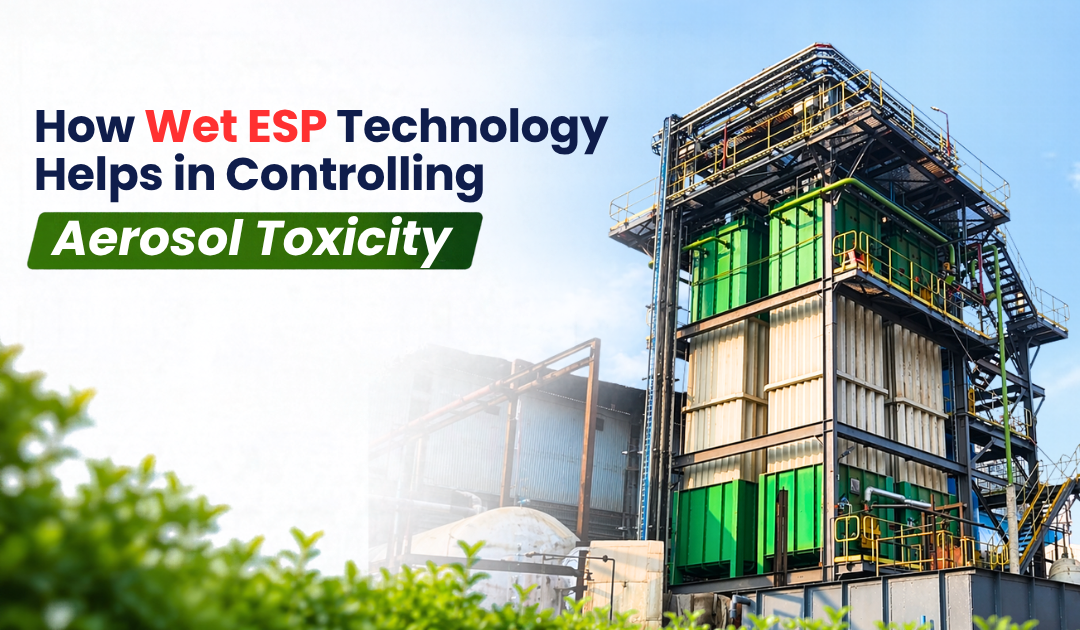
How Wet ESP Technology Helps in Controlling Aerosol Toxicity
Industrial processes can release a complex mixture of airborne pollutants, including fine particulate matter, liquid aerosols, acid mists and metal-bearing particles. These emissions may remain suspended in the atmosphere, travel beyond industrial premises and contribute to environmental pollution. Their impact depends on particle size, chemical composition, concentration and exposure duration. Controlling such emissions requires air pollution control systems that can capture very small particles as well as pollutants that conventional collection equipment may struggle to remove efficiently.
Wet electrostatic precipitators (Wet ESPs) are designed to collect fine particles and liquid droplets from industrial exhaust gases. They use an electrical charging and collection process, followed by periodic washing of the collection surfaces. This makes the technology particularly relevant to processes that generate sticky, corrosive or high-resistivity particulate matter.
For industries seeking better control over industrial emissions and aerosol toxicity, Wet ESP technology can provide an additional stage of particulate and mist removal. Enviropol focuses on industrial air pollution control solutions, where understanding the characteristics of emissions is an important part of selecting suitable treatment technology.
Understanding Aerosol Toxicity in Industrial Emissions
An aerosol is a suspension of solid particles or liquid droplets in a gas, such as flue gas, air. Industrial aerosols can originate from combustion, smelters, kilns, chemical reactions, material processing, metal production, surface treatment and several other manufacturing activities. Depending on the process, they may contain dust, smoke, oil mist, acid droplets, condensed vapours or metal compounds.
Aerosol toxicity refers to the potential harmful effects associated with exposure to these airborne particles and droplets. Not every aerosol is equally hazardous. Its risk depends on the substances present, their concentration, particle size, chemical behaviour and the length of exposure.
Fine particles are a particular concern because they can remain airborne for extended periods and penetrate deeper into the respiratory system than larger particles. Some industrial aerosols may also carry toxic substances, including lead, chromium, nickel, cadmium and other metals, depending on the raw materials and processes involved.
Industrial emissions and aerosol toxicity therefore need to be evaluated together. Measuring only the total dust concentration may not provide enough information about the actual pollution burden. Industries must also consider particle-size distribution, chemical composition and the presence of liquid mists or hazardous constituents.
What Is Wet ESP Technology?
A Wet Electrostatic Precipitator (Wet ESP or WESP) is an air pollution control device that uses high-voltage electricity to remove suspended particles and liquid droplets from industrial gas streams. It works on the principle of electrostatic attraction. Unlike conventional filtration systems that rely on a physical filter medium, a Wet ESP electrically charges particles and moves them towards collection surfaces.
The main components generally include:
- Discharge electrodes: Enviropol patented electrode design generates a high-voltage electric field and produces ions that charge particles in the gas stream.
- Collection electrodes: Provide surfaces that attract and collect electrically charged particles. It can be in shapes such as circular, hexagonal, square, plate type.
- High-voltage power supply: Maintains the electrical conditions required for particle charging and collection.
- Washing system: Uses periodic water flushing to rinse collected material from the collection surfaces.
- Drainage and wastewater handling: Collects the wash water containing removed particles and directs it for appropriate treatment.
The US Environmental Protection Agency (EPA) identifies Wet ESP as Best Available Technology (BAT) suitable for collecting particulate matter, aerosols, acid mist, oil mist, as well as particulate hazardous air pollutants such as many metals. They are also commonly used for blue haze or white plumes removal from stack.
How Wet ESP Helps in Controlling Aerosol Toxicity
Wet ESP technology contributes to aerosol toxicity control by reducing the concentration of fine particles, liquid droplets and particulate-bound contaminants in industrial exhaust gases. Its effectiveness comes from the combination of electrical particle collection and wet cleaning.
1. Electrical Charging of Fine Particles
When contaminated gas enters the Wet ESP, it passes through an electrical field created by high-voltage discharge electrodes. The electrical discharge generates ions, which attach to suspended particles and give them an electrical charge.
The charged particles are then influenced by the electric field and move towards collection surfaces carrying the opposite charge. This process allows the system to capture particles that may be difficult to remove through conventional mechanical separation alone.
2. Collection of Submicron Particles
Submicron particles have diameters below one micron. They are particularly challenging to capture because their small size allows them to remain suspended in moving gas streams. Some industrial processes produce these particles through condensation, combustion, chemical reactions and high-temperature material processing.
A properly designed Wet ESP can collect a significant proportion of these fine particles. This makes submicron particle removal Wet ESP an important consideration in applications where conventional dust collection is not sufficient to achieve the required emission levels.
The EPA's technical fact sheets identify PM2.5 collection as an applicable function of Wet ESP systems. Actual performance depends on equipment design, gas conditions, particle properties and operating parameters.
3. Removal of Acid Mists and Liquid Aerosols
Industrial gas streams may contain acid mists, condensable droplets and other liquid aerosols. These can originate from chemical processing, metallurgical operations, combustion and wet gas-cleaning processes.
Wet ESPs are particularly useful in applications involving acid mist because electrically charged droplets can be collected on the electrodes and washed away. This reduces the amount of liquid aerosol carried towards the exhaust outlet.
Unlike dry collection systems, the wet cleaning mechanism also helps prevent collected sticky or moist material from accumulating as a dry layer on collection surfaces. This is one reason Wet ESP technology is used in certain chemical and metallurgical applications.
4. Control of Toxic Metals Attached to Particles
Some industrial particulate emissions contain metals such as lead, chromium, nickel and cadmium. These substances may be present in dust, fumes or condensed particles generated during processes such as metal smelting, refining, combustion and waste treatment.
When these metals are present in particulate form, a Wet ESP can capture the particles carrying them. This is relevant to toxic metals in industrial PM2.5 emissions, where the objective is not simply to reduce visible dust but also to limit the release of particulate-bound contaminants.
However, it is important to distinguish between metals attached to particles and metals present as gases or vapours. A Wet ESP primarily collects particulate matter. It should not be treated as a complete solution for gaseous mercury or other contaminants that remain in vapour form. Such pollutants may require additional treatment technologies.
Wet ESP and Fine Particulate PM2.5 Control in Industrial Facilities
PM2.5 refers to particulate matter with an aerodynamic diameter of 2.5 micrometres or less. These particles can originate from combustion, industrial processing, chemical reactions and the condensation of vapours. Their small size allows them to remain suspended in the atmosphere and penetrate deep into the respiratory system when inhaled.
Fine particulate PM2.5 control industrial applications require technologies capable of addressing particles that may pass through less suitable collection systems. Wet ESPs can be installed as a final particulate-control stage, often downstream of other pollution-control equipment.
For example, an industrial facility may use a scrubber to remove soluble gases and larger particulate matter, followed by a Wet ESP to capture remaining fine particles and mist droplets. The exact arrangement depends on the process, gas composition, temperature, moisture content and emission-control requirements.
Wet ESP technology is also relevant where the exhaust contains high-resistivity or sticky particles. In dry ESP systems, certain particle characteristics can affect collection and removal from the electrodes. Wet cleaning helps maintain the collection surfaces by washing away accumulated material.
Wet ESP as an Aerosol Toxicity Control Technology
The selection of an aerosol toxicity control technology depends on the type of pollutant, its physical and chemical properties, the concentration in the gas stream and the required outlet emission level. Wet ESPs are not universal gas-treatment systems, but they can play an important role in controlling particulate-bound pollutants and liquid aerosols.
Some of their key operational characteristics include:
- Fine particle collection: Helps reduce submicron particles.
- Acid mist removal: Captures fine liquid droplets generated during industrial processing.
- Sticky particle handling: Water washing helps prevent the build-up of collected material on electrodes.
- Particulate-bound metal control: Removes particles carrying metals and other hazardous substances.
- Low gas-side resistance: Wet ESP systems can generally operate with relatively low pressure drop, although actual values depend on the design and installation.
These characteristics make Wet ESPs relevant to industrial facilities that need an additional control stage after primary dust collection or gas scrubbing.
Industrial Applications of Wet ESP Technology
Wet ESP systems are used across industries where fine particulate matter, acid mists and other aerosol emissions need to be controlled. Their suitability depends on the composition of the exhaust gas and the characteristics of the pollutants.
Some important applications include:
1. Metal Processing and Smelting
Metal production and refining can release fine metal fumes, oxide particles and other particulate pollutants. Wet ESP can collect particulate-bound metals and fine aerosols from suitable exhaust streams, helping reduce emissions from metallurgical operations.
2. Chemical Manufacturing
Chemical plants may generate acid mists, sulphuric acid, condensable droplets and fine particulate emissions during production. Wet ESP can be used to collect these pollutants, particularly when installed after suitable gas-conditioning or scrubbing equipment.
3. Power Generation
Combustion processes can produce fly ash, fine particulate matter and sulphuric acid mist. Wet ESP can serve as a secondary collection stage to reduce residual particulate and mist emissions after upstream pollution-control systems.
4. Waste Incineration
Waste treatment and incineration can release fine particles containing various inorganic substances and metals. Wet ESP can help capture particulate-bound contaminants from appropriately conditioned exhaust gases.
5. Mineral Processing
Mineral processing operations may generate fine dust, condensed fumes and acid mist. Wet ESPs can provide additional particulate collection where conventional dust-control arrangements do not adequately address the remaining emissions.
6. Blue Haze or White Plumes removal
Wet ESP technology is the most suitable technology to reduce white plumes or blue haze from the stack or chimney. With Wet ESP or WESP, industry can achieve smoke free or smoke less stack.
Factors That Influence Wet ESP Performance
The efficiency of a Wet ESP depends on more than its electrical design. The characteristics of the incoming gas stream and the operating conditions also influence pollutant collection.
Important factors include:
- Particle size distribution: The size and concentration of particles influence their charging and collection behaviour.
- Gas flow rate: Gas velocity and residence time affect the opportunity for particles to reach collection surfaces.
- Electrical conditions: Voltage, current and electric-field strength influence particle charging and movement.
- Gas temperature and moisture: These affect gas properties, condensation and the behaviour of particulate matter.
- Pollutant composition: Chemical characteristics, particle resistivity and the presence of sticky or corrosive substances influence equipment selection.
- Washing arrangements: Proper water distribution and collection help remove deposited pollutants from the electrodes.
- Material selection: Corrosion-resistant construction materials may be necessary when handling acidic or chemically aggressive gas streams.
A suitable design should therefore begin with an assessment of the industrial process, inlet gas conditions and required emission limits.
Important Considerations and Limitations
Although Wet ESP technology offers several advantages, its performance should be evaluated according to the actual application. It does not automatically eliminate every pollutant present in an industrial exhaust stream.
For example, gaseous contaminants may require absorption, adsorption or other specialised treatment. Mercury is an important example because a significant portion of its emissions may occur in elemental vapour form, which a particulate collector cannot effectively remove by itself.
Wet ESPs also produce wastewater containing the collected particulate matter and dissolved substances. This water requires suitable handling and treatment before reuse or disposal. In addition, electrode maintenance, electrical safety, corrosion resistance and consistent washing arrangements must be considered during system design.
Another important consideration is aerosol formation under certain operating conditions. Research has shown that poorly selected or operated Wet ESP conditions can contribute to the formation of ultrafine droplets in specific applications. Therefore, proper engineering, testing and performance monitoring are essential.
Enviropol's Approach to Industrial Aerosol Emission Control
Effective industrial pollution control begins with understanding what a facility releases into the atmosphere. Particle size, chemical composition, gas temperature, moisture levels and pollutant concentration all influence the choice of treatment equipment.
Enviropol focuses on industrial air pollution control requirements, where technologies such as Wet ESPs can be evaluated as part of an integrated emission-management system. The objective of selecting an appropriate solution is to address the specific characteristics of industrial exhaust rather than relying on a single technology for every type of pollutant.
For facilities dealing with fine particulate matter, acid mists and particulate-bound contaminants, Wet ESP technology can provide an additional stage of emission control. Its integration with scrubbers, dust collectors and other treatment systems should be based on process conditions and applicable environmental standards.
By understanding the relationship between industrial emissions and aerosol toxicity, industries can make more informed decisions about emission monitoring, equipment selection and pollution-control strategies.
Frequently Asked Questions
1. What is a Wet Electrostatic Precipitator?
A Wet Electrostatic Precipitator is an industrial air pollution control device that uses high-voltage electricity to charge and collect suspended particles and liquid droplets. Water washes the collected pollutants from the electrodes, helping maintain clean collection surfaces.
2. How does Wet ESP technology help control aerosol toxicity?
Wet ESP technology captures fine particulate matter, acid mists and droplets that may carry hazardous substances. By reducing these pollutants in industrial exhaust gases, it helps limit the release of particulate-bound contaminants into the surrounding atmosphere.
3. Can a Wet ESP remove PM2.5 emissions?
Yes. Wet ESP systems are designed to collect fine particulate matter, including PM2.5. Their actual removal performance depends on particle characteristics, gas flow, electrical conditions, equipment design and operating parameters.
4. How does Wet ESP support submicron particle removal?
A Wet ESP electrically charges suspended particles and attracts them towards collection electrodes. This mechanism enables the collection of certain submicron particles that can be difficult to remove through conventional mechanical collection methods.
5. Can Wet ESP technology control toxic metals in industrial emissions?
Wet ESPs can capture particulate-bound metals such as lead, chromium, nickel and cadmium when these substances are attached to airborne particles. However, metals present in gaseous or vapour form may require additional treatment technologies.
6. Which industries can benefit from Wet ESP systems?
Metal processing, chemical manufacturing, power generation, mineral processing and waste incineration facilities may benefit from Wet ESP technology. Its suitability depends on the composition of the exhaust gas and the pollutants requiring control.
7. Does a Wet ESP require wastewater treatment?
Yes. The washing process produces wastewater containing collected particles and dissolved substances. This wastewater must be collected and treated appropriately before reuse or disposal to prevent secondary pollution.