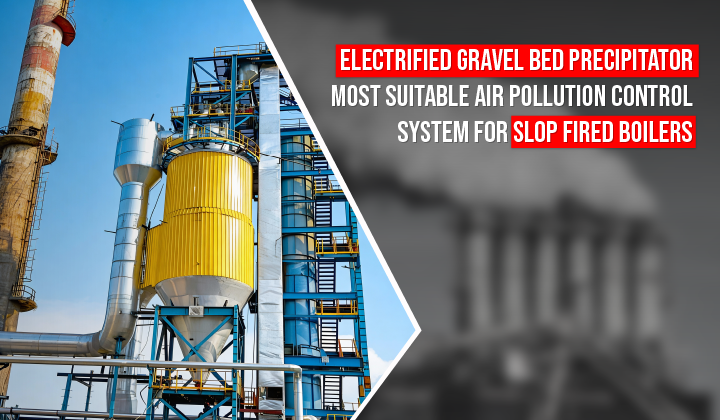
Electrified Gravel Bed Precipitator: Most suitable Air Pollution Control Solution for Slop-Fired Boilers
Industrial boilers are still essential across different sectors - particularly in distilleries, sugar production, biomass processing, as well as chemical manufacturing. One particular kind, a steam fired boiler, is utilized to ignite the slurry-like effluent (slop) typically resulted from the fermentation process or any other. While this method can aid in managing effluent and reaching Zero Liquid Discharge (ZLD) goals, it also presents specific challenges when it comes to emission control.
Particulate control systems that are conventional like electrostatic precipitators (ESPs) typically have to contend with varying gas compositions as well as high dust resistance and fine particles in the combustion flue gases of slop. In these situations the Electrified Gravel Bed Precipitator (EGB) is a viable option as a reliable, effective and economical solution. This blog focuses on the advantages of this technology and the way it can be applied specifically to boilers that are slop fired.
Understanding Slop Fired Boilers
What is Slop Fired Boiler?
Slop fired boilers are specialized combustion systems designed to burn slop, a viscous and high-organic wastewater byproduct from processes such as distillery fermentation or sugar production. Slop typically contains high concentrations of solids, organic matter, and moisture -- making it difficult to treat using conventional wastewater methods.
Slop firing:
• Ends effluent discharge problems
• Helps meet ZLD goals
• Generates steam for process use
• Reduces dependence on freshwater discharge
However:
• Slop combustion produces flue gases with high particulate loads
• Large quantities of fine particulates (< 2 micron) are released
• Traditional particulate control systems may not be effective
Why Particulate Control Matters?
Particulate emissions lead to:
• PM10 and PM2.5 air pollution
• Local smog formation
• Chronic respiratory health issues
• Environmental pollution
Industrial regulations in India and globally require particulate emissions to be kept below specific limits -- often 30 - 50 mg/Nm3 for stack emissions. Achieving this is especially challenging with slop fired boilers due to:
• Fine particulate sizes
• Variable fuel composition
• High moisture content
• Sticky combustion residues
Limitations of Traditional APC Technologies
Electrostatic Precipitators (ESP)
ESP works on charged particles in the gas stream and collects them on electrodes. They can achieve very high removal efficiencies (> 99%) in many applications. However, in slop fired boiler off-gas streams:
• Fine particulates often have high resistivity, reducing ESP efficiency
• High moisture and condensable vapors can neutralize the electric charge
• Variable gas compositions complicate stable operation
• Rapper re-entrainment of ash particles
Bag Filters (Fabric Filters)
Bag filters capture dust using filter media. While they are often effective at collecting smaller particulates, they can:
• Become clogged due to sticky residues from slop combustion
• Require frequent maintenance
• Have higher operational costs due to frequent bag replacements
Given these limitations, industries need technologies capable of handling the unique characteristics of slop combustion emissions. This is where Electrified Gravel Bed Precipitators (EGB) excel.
What Is an Electrified Gravel Bed Precipitator (EGB)?
An Electrified Gravel Bed Precipitator also known as vertical ESP, is a type of particulate control device that combines electrical precipitation and a fixed collection medium (gravel bed). Instead of using smooth metal plates, EGB uses gravel that becomes the surface for collecting charged particles. Electrified Gravel Bed Precipitator manufacturers focus on long-term sustainability of the product to make it cost-effective and feasible.
Basic Working Principle
• Flue gas enters the precipitator
• Particles are electrically charged using a pre charger
• Charged particles stick on the polarized gravel bed
• Particles adhere to gravel surfaces and are collected
• The cleaned gas exits to the atmosphere.
• The gravels are cleaned using air purging in a gravel cleaner and are recirculated back in the system using a bucket elevator.
This hybrid design increases surface area for particle deposition and improves collection efficiency - especially for fine particulates that challenge conventional ESP.
Why EGB Works Well for Slop Fired Boilers?
EGB offer several advantages in dealing with slop combustion emissions:
1. Enhanced Capture for Fine Particulates
Because the gravel bed provides a large surface area, even very small particles (< 2 micron) can be captured more effectively than in traditional ESP systems. Studies have shown that electrified media collectors can achieve efficiencies comparable to or exceeding conventional ESP, especially for particles in less than 2 micron size range- the most harmful for human health and the environment.
2. Less Impact from High Resistivity of Ash
High dust resistivity (common in slop combustion) usually reduces the electrical field effectiveness in ESP. In contrast, the electrified gravel bed precipitator works on the principle of differential voltage, which does not have any effect on collection efficiency due to particle resistivity, results in achieving consistent outlet emission.
3. Ash collection
The ash coated Gravels are collected and cleaned outside the gas stream. The gravels are cleaned using air purging, the ash is separated and conveyed to the ash silo, and the cleaned gravels are recirculated back into the system using a bucket elevator. This results in no re-entrainment of ash unlike ESP.
4. Lower Operating Costs
• Lower energy per unit mass of gas processed
• Less frequent maintenance compared to conventional technologies
• Very Less footprint due to modular shape design.
• Faster erection and commissioning time.
• Lesser transportation cost due to the pre-assembled system.
Performance Data: EGB in Industrial Applications
Characteristics for strong performance are:
• Particulate Removal Efficiency: 99.9% removal.
• Stack Emission Levels: EGB can help achieve emissions below regulatory limits (~30 mg/Nm3 or lower consistently), particularly when coupled with a pre dust collector.
• No downtime required
Note: Actual performance depends on design, gas composition, and operating conditions.
Integration of EGB with existing APC Systems
Existing ESP & Cyclone systems can be upgraded with Electrified Gravel Bed.
In many industries, EGB is used as a polishing filter to meet stringent emission norms:
Environmental & Operational Benefits
1. Reduced health impact - Particulate reduction and, in particular, PM2.5 management, reduces the risk of cardiovascular and respiratory illness for the population around it which is a goal that is backed by public health institutions, including those of the World Health Organization (WHO).
2. Conformity with Norms: The EGB technology is able to help industrial establishments to comply with strict government emission standards.
3. Cost Efficiency with lower maintenance and energy consumption than traditional systems, and greater flexibility over ESP, EGB can be cost-effective over the long term, particularly in difficult flue gas-rich environments.
4. Stable Long-Term Operation - Lower the sensitivity to fluctuations in fuel and lesser frequent cleaning cycles contribute to a higher level of uptime, which is crucial for companies that run continuously.
Design and Installation Considerations
When engineering an EGB solution for a slop fired boiler, consider:
• Gas Composition & Temperature
• Particulate Characteristics
• Space availability
Conclusion
Electrified Gravel Bed Precipitators offer a compelling solution for particulate control in slop fired boiler applications- combining the strengths of electrical precipitation and particulate media collection to handle variable flue gas conditions and fine particulate pollutants.
With growing environmental concerns, tightening emission norms, and rising awareness of public health impacts, industries burning effluent streams like slop must adopt resilient, efficient, and cost-effective APC technologies. EGB -- especially when integrated with other control devices -- can play a pivotal role in helping such facilities achieve compliance, reduce operational costs, and attain long-term sustainable performance.
Discover how Electrified Gravel Bed Precipitators manufacturers can revolutionize industrial air pollution control. Explore Enviropol’s innovative solutions today and take the first step toward cleaner, greener operations!