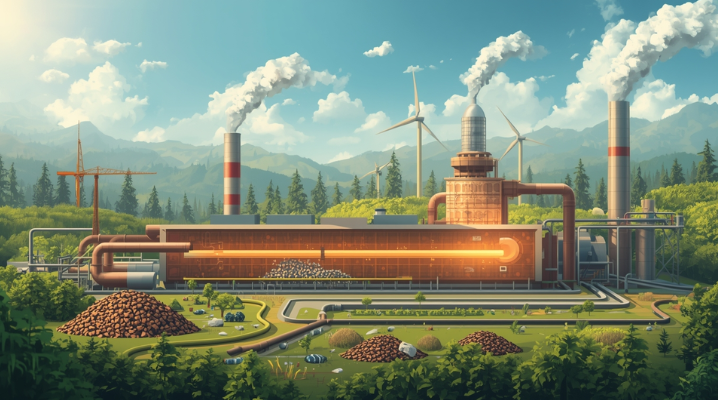
Biomass Gasification: Turning Organic Waste into Sustainable Energy
With the world trying to find clean and renewable forms of energy, the biomass gasification has emerged as a potential source of sustainable energy. The process is innovative and it converts the organic waste materials- agricultural residues, wood chips and other biomass into a combustible gas referred to as producer gas. The technology is also capable of minimizing waste as well as assisting in the production of clean energy and beneficial by-products.
Defining Biomass Gasification
Biomass gasification is a thermo-chemical reaction, which transforms solid biomass into carbon monoxide (CO), hydrogen (H2), as well as methane (CH4). This is realized through heating of biomass in an enclosed environment with limited oxygen. The resulting so-called syngas or producer gas may be utilized to create electricity or provide heat or be used as a raw material to a variety of chemical and fuel processes. In contrast to the direct combustion, the gasification has greater efficiency and reduced emissions.
Production of Syngas from Biomass Gasification
Biomass gasification produces a mixture of combustible gases, commonly known as syngas, consisting primarily of carbon monoxide (CO), hydrogen (H₂), methane (CH₄), and small amounts of carbon dioxide (CO₂) and nitrogen (N₂). However, the raw syngas generated from the gasification process also contains impurities such as tar, dust, and fine particulate matter that can damage downstream equipment or reduce system efficiency.
To ensure the syngas meets the required purity standards for further use in engines, turbines, or synthesis processes, a Wet Electrostatic Precipitator (WET ESP) system is employed for cleaning. The WET ESP effectively removes fine particulates, aerosols, and mist from the syngas stream by applying an electric field that charges the particles and collects them on grounded surfaces, which are continuously flushed with water. This method ensures high-efficiency gas cleaning, minimal pressure drop, and reliable operation, resulting in cleaner syngas suitable for energy generation or chemical production applications.
Biomass Gasification Power Plants Applications
A biomass gasification power plant makes use of the syngas to power gas engines or turbines to generate electricity which can be fed to the local grids or as captive consumption. These plants are particularly useful in rural regions where there is a large amount of biomass and the supply of electricity is unreliable. In addition to power production, these systems may be used to supply heat to industrial processes or district heating to add to sustainable and decentralized energy solutions.
Production of Hydrogen by Biomass Gasification
Biomass gasification to produce hydrogen is considered one of the most thrilling developments in this field. Hydrogen energy is a clean fuel that is increasingly being looked upon globally as a renewable source of hydrogen to replace transportation, power, and industry. Gasification enables the hydrogen to be extracted out of biomass which will curb the reliance on fossil fuels and lead to the creation of a green hydrogen economy. This renders it an essential connection between renewable energy and hydrogen based systems of the future.
The Biomass Gasification in India
India is a country with a big agricultural foundation producing cropping residues in millions of tonnes in a year. Biomass gasification in India is a sustainable alternative to use this vast resource to provide the rural population with electrification opportunities as well as with minimizing air pollution associated with the open burning of residues. There has been increased interest by the Indian government and the Indian private sector in popularizing biomass-based technologies as a part of the renewable energy transition in the country.
Expansion of Biomass Gasification Plant in India
In India, the gasification of biomass fuel power plants are constantly on the rise, especially in such states as Uttar Pradesh, Maharashtra, and Tamil Nadu. These installations are assisting industries and communities to cut their carbon footprint besides gaining independence on energy. This sector is growing due to continuous innovation, support for policy, and awareness of environmental sustainability, which makes India a candidate for the biomass-based energy systems.
Making organic waste transform into clean useful energy, biomass gasification will provide a sustainable way to reach a low-carbon future. As corporate entities such as Enviropol promote the latest in renewable energy technologies, biomass gasification technology use is still on the rise in India and other places.