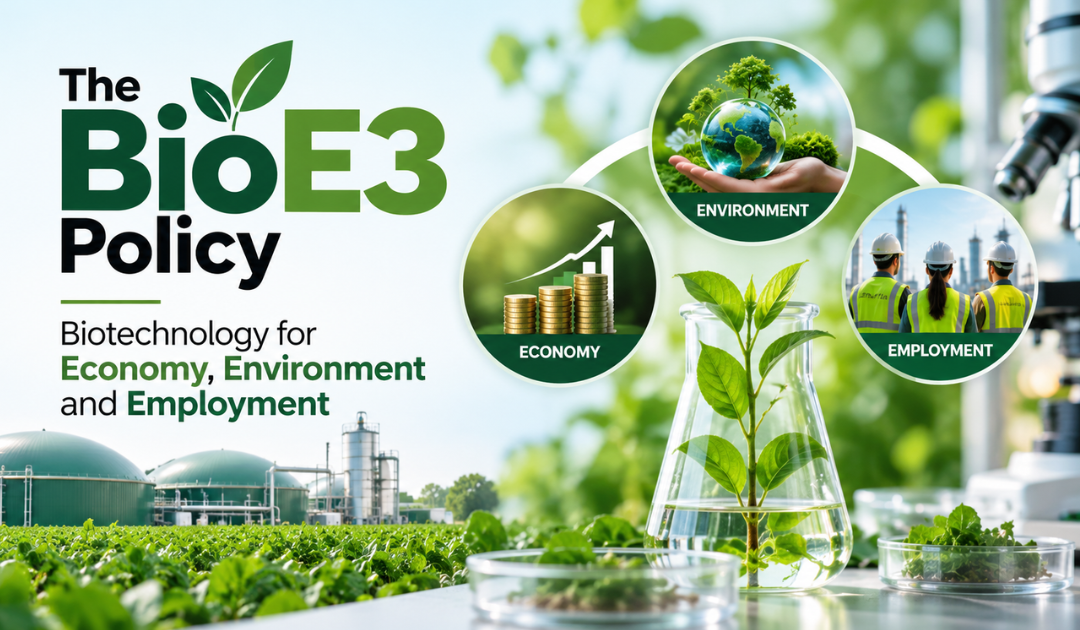
The BioE3 Policy: Biotechnology for Economy, Environment and Employment
India is increasingly looking at biotechnology not only as a scientific discipline but also as a foundation for sustainable manufacturing, economic growth, environmental protection, and employment generation. The BioE3 Policy, formally approved by the Union Cabinet on 24 August 2024, is designed to foster high-performance biomanufacturing and strengthen India's emerging bioeconomy. It seeks to connect biotechnology with engineering, digital technologies, entrepreneurship, and industrial-scale production.
For businesses and organisations working around sustainability, environmental management, clean technologies, and resource efficiency, the policy is particularly significant because it promotes bio-based alternatives, circular production models, and technologies that can reduce dependence on conventional fossil-based inputs.
What Is the BioE3 Policy?
The BioE3 Policy India framework stands for Biotechnology for Economy, Environment and Employment. It establishes a policy framework for accelerating innovation-driven research, entrepreneurship, technology development, and commercialisation in high-performance biomanufacturing.
The policy aims to move biotechnology discoveries beyond laboratories and toward scalable industrial applications. This includes supporting technologies capable of producing bio-based chemicals, materials, food products, therapeutics, agricultural solutions, and other high-value products.
A central idea behind BioE3 is the integration of biotechnology with engineering and advanced digital technologies. By combining areas such as synthetic biology, genomics, metabolic engineering, artificial intelligence, and precision fermentation, India can develop more efficient ways of designing and producing biological products.
The policy also supports the development of infrastructure that can help researchers, start-ups, academia, and industry move from proof-of-concept research to pilot and pre-commercial production. This makes the policy important not only for scientific institutions but also for the wider industrial ecosystem.
Why Was the BioE3 Policy Introduced?
Traditional manufacturing systems often depend heavily on fossil-based raw materials, energy-intensive processes, and linear consumption patterns. These approaches can contribute to resource depletion, pollution, greenhouse-gas emissions, and waste generation.
The BioE3 framework seeks to encourage a shift toward more sustainable and regenerative manufacturing approaches. Biological systems can potentially be used to produce materials, chemicals, food ingredients, medicines, and other products through processes that offer alternatives to conventional industrial synthesis.
The policy is also connected with India's broader Green Growth, Net Zero, and Lifestyle for Environment (LiFE) priorities. By promoting circular bioeconomy models, BioE3 seeks to support economic development while considering environmental and climate impacts.
Another important reason for the policy is India's ambition to strengthen domestic capabilities. Developing indigenous technologies, production platforms, and manufacturing infrastructure can help reduce dependence on imported materials and technologies while creating opportunities for Indian researchers and businesses.
The policy therefore brings together three interconnected objectives: creating economic value through biotechnology, supporting environmental sustainability, and generating skilled employment through new industries and innovation-led enterprises.
What Are the Strategic Sectors Under the BioE3 Policy?
The BioE3 Policy strategic sectors have been identified according to national priorities and opportunities for high-performance biomanufacturing. Six broad thematic areas have been prioritised.
1. Bio-Based Chemicals, Biopolymers and Enzymes
This area focuses on developing biological routes for producing chemicals, polymers, enzymes, and other industrial inputs. Indigenous microbial strains, strain engineering, metabolic pathway optimisation, and scalable biomanufacturing are important components.
Bio-based manufacturing can provide alternatives to certain conventional chemical processes and support the development of more sustainable industrial production systems.
2. Functional Foods and Smart Proteins
The policy also focuses on next-generation food technologies, including functional foods and smart proteins. These areas can support innovation in nutrition, food production, alternative protein systems, and value-added biological products.
3. Precision Biotherapeutics
Precision biotherapeutics focuses on advanced healthcare solutions that can address diseases with greater specificity. Biotechnology can support the development of innovative therapies, biological products, and precision-oriented treatment approaches.
4. Climate-Resilient Agriculture
Agriculture is particularly vulnerable to changing climatic conditions. BioE3 therefore supports biotechnology-driven solutions that can improve agricultural resilience, productivity, resource efficiency, and adaptation to climate-related challenges.
5. Carbon Capture and Utilisation
Carbon capture and utilisation is another major focus area. Biotechnology can contribute to systems that capture carbon and potentially convert it into useful products, supporting efforts toward lower-carbon industrial models.
6. Marine and Space Research
The policy also recognises the future potential of marine and space biotechnology. Biological resources and extreme environments can provide opportunities for discovering new materials, organisms, processes, and technologies.
How Will BioE3 Support Biomanufacturing?
A major component of the policy is the creation of Biomanufacturing Hubs, Bio-AI Hubs and Biofoundries. These facilities are intended to provide infrastructure and resources required to develop and scale bio-based technologies.
Biofoundries can help researchers and innovators design, build, test, and optimise biological systems more efficiently. The integration of automation, data, artificial intelligence, synthetic biology, and engineering can accelerate development cycles and improve the transition from laboratory research to commercial applications.
Biomanufacturing hubs, meanwhile, can provide access to shared infrastructure for pilot and pre-commercial-scale production. This is particularly valuable for start-ups, small and medium enterprises, academic institutions, and industries that may not have access to expensive scale-up facilities.
Bio-AI hubs add another dimension by using data-driven approaches and artificial intelligence to support biological research. Their applications can include biomolecular design, agricultural innovation, genome diagnostics, and synthetic biology.
Together, these initiatives are intended to create an ecosystem where scientific discoveries can be translated into usable products and technologies.
BioE3 Policy and Environmental Sustainability
Environmental sustainability is one of the defining elements of the BioE3 framework. Instead of viewing manufacturing only through the conventional production-consumption model, the policy promotes a transition toward regenerative and circular bioeconomy approaches.
Bio-based manufacturing can create alternatives to some fossil-derived chemicals, materials, and fuels. The government has also identified measurable targets related to technology development and scale-up for bio-based alternatives intended to replace fossil-based inputs.
This approach has significance for environmental management because reducing reliance on fossil-derived raw materials can support resource diversification and potentially lower environmental impacts associated with conventional production.
The policy's emphasis on carbon capture and utilisation is another important environmental dimension. Developing biological technologies that can capture and convert carbon into useful products could contribute to broader decarbonisation efforts.
However, the environmental benefits of individual biomanufacturing technologies depend on factors such as feedstocks, energy consumption, production efficiency, lifecycle impacts, waste management, and scalability. Therefore, biotechnology-based solutions need to be assessed through a complete sustainability perspective rather than assuming that every bio-based product automatically has a lower environmental footprint.
How Can BioE3 Contribute to Employment?
The employment dimension of the BioE3 Policy extends beyond traditional biotechnology research jobs. As biomanufacturing expands, demand can increase for professionals across research, engineering, manufacturing, quality control, data science, process development, product commercialisation, and business development.
The policy also emphasises entrepreneurship and the development of an ecosystem where start-ups and emerging companies can transform scientific innovations into commercial products.
Biofoundries and Biomanufacturing Hubs are expected to contribute to human-resource development through training and internships. This can help build interdisciplinary skills combining biology, engineering, digital technologies, and industrial processes.
Such workforce development is important because advanced biomanufacturing requires professionals who understand both biological systems and industrial-scale production. The resulting ecosystem can create opportunities for scientists, engineers, technicians, entrepreneurs, researchers, and specialised service providers.
In this way, the employment objective of BioE3 is linked directly to its economic and technological objectives. Building manufacturing capabilities can create demand for skilled people while creating new markets for biotechnology-based products and services.
BioE3 Policy and India's Bioeconomy Growth 2047
The BioE3 Policy is closely connected with India's long-term ambition to build a large and globally competitive bioeconomy. According to the India Bioeconomy Report 2026, India's bioeconomy reached an estimated $195.3 billion in 2025, following substantial expansion from $10 billion in 2014.
The report identifies a $300 billion bioeconomy target for 2030 and presents a longer-term vision of a $1 trillion bioeconomy by 2047. This demonstrates how biotechnology is increasingly being considered a major contributor to India's economic development rather than a narrowly defined scientific sector.
BioE3 can support this trajectory by strengthening industrial biotechnology, biomanufacturing infrastructure, entrepreneurship, research translation, and technology commercialisation. Its six strategic sectors also provide opportunities across healthcare, agriculture, food, chemicals, materials, carbon management, marine resources, and space research.
The long-term opportunity is therefore broader than simply increasing the number of biotechnology companies. India needs scalable manufacturing, skilled talent, strong research-industry connections, reliable infrastructure, responsible regulation, and markets capable of adopting bio-based products.
Role of BioE3 in Building Viksit Bharat 2047
BioE3 has been positioned as part of India's broader vision for Viksit Bharat 2047. The policy connects biotechnology-led economic development with environmental responsibility, technological capability, and employment creation.
The government has also encouraged states to establish BioE3 Cells to strengthen coordination between state-level ecosystems and national stakeholders. Such collaboration can help states use their regional resources, scientific capabilities, industries, and economic strengths to develop biotechnology opportunities suited to local conditions.
This decentralised approach is important because India's biological resources and industrial capabilities vary significantly across regions. Marine resources, agricultural ecosystems, research institutions, industrial clusters, and Himalayan or other specialised bio-resources can support different areas of biomanufacturing.
The long-term objective is to create an ecosystem in which biotechnology contributes to economic value while supporting sustainability and employment. In April 2026, the government also highlighted a projected $1 trillion bioeconomy by 2047, reinforcing the scale of the long-term ambition.
BioE3 Policy and the Future of Sustainable Industry
The BioE3 Policy India represents a shift toward using biology as an industrial resource for solving economic, environmental, and social challenges. Its focus on high-performance biomanufacturing creates a pathway for research discoveries to move toward scalable products and commercial applications.
For environmental sustainability, the policy's emphasis on circular bioeconomy models, bio-based alternatives, carbon capture and utilisation, and climate-resilient agriculture creates opportunities to rethink how resources are produced and consumed.
For the economy, the expansion of biomanufacturing can support domestic production, entrepreneurship, technology commercialisation, and new industrial markets. For employment, it can generate demand for interdisciplinary skills across biotechnology, engineering, manufacturing, AI, research, and business.
The success of BioE3 will ultimately depend on effective implementation, responsible technology development, strong research-industry partnerships, infrastructure availability, skilled talent, appropriate regulation, and the ability to scale promising innovations. If these elements develop together, biotechnology can become an important component of India's transition toward a more sustainable and innovation-led economy.
Conclusion
The BioE3 Policy provides India with a framework for using biotechnology to address three interconnected priorities: economic growth, environmental sustainability, and employment generation. Its focus on six strategic sectors, high-performance biomanufacturing, Bio-AI Hubs, Biofoundries, entrepreneurship, and technology commercialisation makes it an important policy for India's evolving bioeconomy.
With India's bioeconomy already expanding rapidly and long-term ambitions extending toward 2047, the policy can help strengthen domestic biomanufacturing capabilities while encouraging more sustainable production models. For environmental and sustainability-focused organisations such as Enviropol, understanding the BioE3 framework is valuable because it signals the growing role of biotechnology in resource efficiency, cleaner production, carbon management, climate resilience, and circular economy solutions.