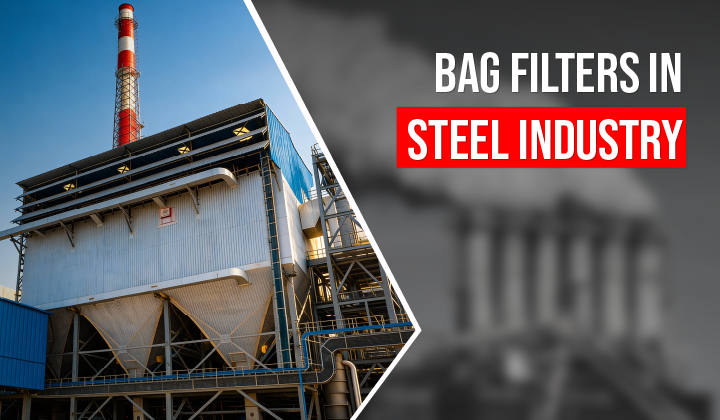
Bag Filters in the Steel Industry
The management of particulate emissions is important in steel plants, not only as a measure of complying with the regulations but also as a way of making operations cleaner and safer to the workers. The bag filter also known as baghouse or fabric filter is among the most efficient technologies capable of extracting exhaust gases and collecting dust. These systems are very central in curbing air pollution, get-back of valuable dust, and enhance efficiency of production.
Cleaner Operations and Lower Emissions
Sintering, pelletising, coke ovens, blast furnace, DRI kilns, basic oxygen furnaces and electric arc furnace processes produce great quantities of dust, fumes and particulate matter during steelmaking. When not treated these emissions cause poor air quality and environmental degradation. Bag filters assist steel plants in ensuring that emissions are not exceeded in the permissible levels as well as minimize the harmful particulate matter prior to the release of it into the atmosphere.
What is a Bag Filter?
A bag filter (also known as a baghouse) is an air cleaner and dust collector used to clean exhaust air to eliminate suspended particles by use of fabric filter bags. When dusty exhaust passes through the baghouse, particulates are retained on the cloth surface as clean air moves to the atmosphere.
Technical Design and Working Principle
Thousands of long bags made of fabric are placed inside a tall housing in parallel inside a bag filter. The dust-laden gas passes through the baghouse and is pulled in through the surface of the fabric. The particles settle together as a dust cake on the bag surface and the purified gas is released to the bags. A cleaning mechanism (periodically) is used to loosen the dust cake, usually by a pulse of compressed air, which collects it into a hopper, to be later discarded or recycled.
Core Technology
Filtration through fabric media is the main engineering principle of a baghouse. It uses a row of fabric filter bags of weaved or felted fabrics to entrap the particulate matter as the contaminated gases flow through.
Key technological components include:
1. Filter Bags: These are typically constructed of a high-temperature and chemical-resistant material (polyester, polypropylene, aramids, or PTFE-coated fabrics).
2. Cage or Support Structure: This gives mechanical support to the filter bags so that they do not collapse under pressure.
3. Dust Collection Hopper: This can be found at the lower part and collects the dust that has been formed.
4. Cleaning System: Adopts pulse-jet, shaker or reverse air cleaning to remove dust on the fabric surface.
5. Ductwork and Fans: Aid the transport of gases in and out of the baghouse, ensuring the adequate airflow and pressure.
Its main mode of operation is such that gases are introduced into the baghouse, where they go over the fabric filters and cleaner gases are emitted or sent back to other processes. The particles of dust are accumulated on the cloth surface and this creates a dust cake which increases the filtration rate.
Processes Parameters Involved in the Working
| Performance Parameter | Typical Range | Influencing Factors | Control Methods |
|---|---|---|---|
| Inlet Gas Temperature | 100°C – 250°C | Process conditions, dust type | Temperature sensors, cooling systems |
| Differential Pressure | 100 - 150 mmwc | Dust loading, filter condition | Differential pressure gauges, alarms |
| Cleaning Frequency | As per pressure drop | Dust accumulation rate | Automated timers, pressure drop signals |
| Air-to-Cloth Ratio | 0.4 – 2 m³/m²/min | Dust properties, fabric type | Flow control devices, fan speed regulation |
The optimal parameters are necessary to obtain a high level of filtration, low pressure drop, and reduced wear of the fabric. Sensors and control systems enable real time monitoring of the cleaners whereby the operators can increase or decrease cleaning cycles and airflow to maximize on performance.
Equipment Configuration
Common baghouse designs are usually modular and therefore include several filter compartments in a series or parallel set up to ensure continuous operation. Depending on capacity, the physical dimensions may be reduced to a small unit processing a few thousand cubic meters per hour to large industrial systems with upto 2,500,000 m3/h.
The evolution of designs has added features that include:
a. Pulse-jet cleaning machines of efficient cleaning with minimum fabric wastage.
b. Filter bags compartments are made modular to facilitate their maintenance and replacement.
c. Processes with high off-gas temperature have high-temperature resistant fabrics.
d. Automated operation and diagnostics control systems.
e. Supply of compressed air to clean the area, discharging of dust and emission monitoring devices are also auxiliary systems in order to assure compliance.
Why are Bag Filters Beneficial for the Steel Industry?
1. High Dust Collection Efficiency
Bag filters have a big range of capturing particles, such as fine dust, smoke, and fumes produced by steelmaking activities. Their cloth media have the capability of catching particles as small as sub-micron with 99.9% efficiency, resulting in cleaner exhaust air.
2. Helps Steel Plants Meet Environmental Regulations
The world regulatory bodies have strict emission regulations on the amount of particulate matter given by steel plants. The separation of dust through filter bags is an efficient way of preventing the imposition of fines and minimal environmental impact since plants are taken care of accordingly, complying with these legal requirements.
3. Suitable for Variable Gas Conditions
Depending on the types of dust that may occur in steel operations, temperatures, and moisture levels, bag filters can be programmed to use varying bag materials (e.g., fiberglass, polyester, PTFE, HT bags). They are flexible in the sense that the gas streams can change their properties.
4. Supports Energy Efficiency & Decarbonisation
The bag filters will reduce waste by catching the dust and allowing the recovery or recycling of particulate matter, as well as, enhancing the overall plant performance. Teenier ducting and process airflow also leads to less drag in the system, and this translates to less energy used in the long run by the fans and blowers.
Applications of Bag Filters in the Steel Industry
Iron & Steelmaking Units
The emissions of sinter plants, pellet plants, coke ovens, DRI plants, blast furnaces, steel melt shops and other primary units of the steelmaking process are restricted by bag filters where the dust and particulates are very high in quantity. Before the gases are released via stacks or further treatment, they collect particulates.
Rolling & Finishing Units
Fine metallic dust and smoke are emitted when the operation is being rolled, cut and finished. Bag filters assist in keeping the air clean and catching such emissions to save the health of workers and downstream equipment.
Material Handling & Auxiliary Systems
The fugitive dust is produced in conveyors, crushers, material transfer points, etc. Localized extraction points are bag filters on hoods and prevent this dust (airborne) thus increasing the cleanliness of the plants.
What is the difference between a Bag Filter and an ESP?
A bag filter essentially entraps particulates on a fabric media by passing gas through, and an Electrostatic Precipitator (ESP) entraps the particulates by passing gas through high voltage electrical fields, and depositing the particulates on plates. Key differences include:
a. Collection Method: Fabric vs. electrical plating.
b. Efficiency: Bag filters are known to have around 99% filtration efficiency on a wide size range of particles.
c. Dust Types: ESPs are capable of dealing with wet/damp particle, high temperature gases whereas bag filters perform well with fine, dry particulates and temperatures upto 250 Deg C. However, today there are metallic and ceramic filter bags which can be used for temperatures in the range of 250 to 300 Deg C as well, even upto 600-700 Deg C.
d. Maintenance and Space: ESPs require more space to install than bag filters; bag filters are smaller.
What causes the failure of filter bags?
Filter bags can fail due to several factors including:
a. Abrasion from handling coarse particles.
b. Chemical degradation when exposed to corrosive gases.
c. High temperature damage beyond the bag material’s rating.
d. Improper cleaning pulse settings leading to premature wear.
e. Incorrect media selection based on particle type or operating conditions.
Ensuring proper material selection, routine monitoring, and maintenance can significantly improve bag life.
When should a bag filter be chosen over an Electrostatic Precipitator?
Bag filters are generally preferred when:
a. Very high filtration efficiency (≥99%) for fine particulate matter is required.
b. Particulate resistivity is varied and unpredictable, making electrical collection like ESP less reliable.
c. Space limitations make large ESP installations impractical.
d. Variable temperature or dust loads make electrical resistivity challenges problematic for ESP performance.
e. In contrast, ESPs are attractive when operating with stable conditions and high dust loads, such as in large power boiler systems.
Conclusion
Bag filters have become an essential tool to a healthier and more environmentally friendly modern steel production with its environmentally unfriendly conditions of dustiness, the need to meet environmental standards, and enhance the performance of the plant. Bag filters are used to ensure that steel plants remain sustainable and in compliance with numerous regulations, with exceptionally high particulate capture rates, frequently in excess of 99%. In practice, when fine particle control and flexibility is important, bag filters in comparison to such alternatives as electrostatic precipitators are usually the preferable choice.
Partner with Enviropol to implement high-performance bag filter solutions that deliver superior dust control, regulatory compliance, and long-term operational reliability. Contact Enviropol today to discuss your plant requirements and discover how our advanced filtration systems can future-proof your steel operations.